| This is a discussion on Official Poker Razor Study thread within the online poker forums, in the Cash Games section; This follows on from a thread about post flop play. What I would like to do is to follow on from what ChuckTs was doing ... |
| | ||||||
![]() |
| |
|
#1 | ||||
| ||||
| Official Poker Razor Study thread This follows on from a thread about post flop play. What I would like to do is to follow on from what ChuckTs was doing about a year ago with poker razor. Stox Combo analyses Pokerazor analysis 2: cbetting against a loose fish http://www.cardschat.com/f50/pokeraz...et-pot-136958/ (http://www.cardschat.com/f50/pokerazor-analysis-1-kq-3bet-pot-136958/) I'd like to start by going back over what he did (as I think this will improve our own understanding) and then maybe take it a bit further. To begin with I'd like this thread to be primarily concerned with c-betting and our villain's likely calling and or raising ranges to our c-bet. I'd like to concentrate just on the flop to begin with because I think we should walk before we run. As this thread is a poker razor thread.. you will need poker razor. http://pokerazor.com/ Next of all I'd like to propose the rule, that whatever conclusions you draw must be demonstrated via poker stove. Otherwise it sort of defeats the purpose of the thread. To begin with I would like to approach this in a scientific type of way. So lets agree upon 1. Ranges for common types of villains. These will be our standard ranges, so lets all agree on them. 2. Common flops. These will be our standard flops. So if we are talking of say a 2 tone low flop then 8h 4h 2s, might be our standard 'low two tone flop' Once we have agreed upon standard ranges for our villain types and a range of flops that give us a picture of how that villain performs on generic flops, then we can start plugging that info into poker razor and figuring out what it all means. We can later digress from this, but to begin with I really do think the standardised villains and standard flops will really help. Just remember the golden rule.. whatever you come up with must be demonstrated in Poker Razor. Hopefully this should be an interesting project and one where we all improve our post flop play. |
| Play Texas Hold'em Online Poker | Official Poker Razor Study thread | |
|
|
|
#2 | ||||
| ||||
| So the first task is to define our standard villian ranges. I think the best way would be to assign them firstly a name and their overall V$IP/PRF. I.e. fish 72/4 and the break that range down into EP MP and LP. however if anyone can think of a better way.. now is the time to voice it because its going to be a pain if we later decide we have to go back and do it all again because we seriously screwed up on the ranges!!! |
|
#3 | ||||
| ||||
| Starting out simple is good. I think a good place to start is with cold calling ranges. Fish calls top %30/%20/%60/whatever, tag calls %7 suited connector/pair type range, tricky lag/tag plays similar %7 range, but flats monsters once in a while, etc etc. Then maybe 3betting ranges etc You don't have to be super-specific, just start out with rough 'loose' or 'tight' ranges, try polarized vs unpolarized, mixing in suited connectors and stuff, etc and seeing how they change based on flop textures. |
|
#4 | ||||
| ||||
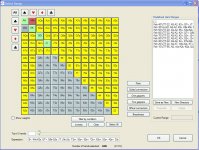
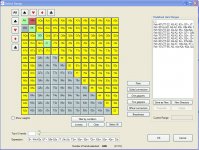
| OK these are the cold calling ranges I would suggest for fishy players. They have a raising range of 3% {JJ+, AK} So essentially these are just slightly adjusted ranges with {JJ+ AK} removed. Fish 10% {TT-66, AQ, AJs-A2s, KQs, QJs} Fish 20% {TT-22, AQ-AT, A9s-A2s, KT+, K9s-K8s, QT+, Q9s, JT, J9s, T9s} Fish 30% {TT-22, AQ-A2, KJ+, KTs-K2s, QJ, QTs, JTs, T9s, 98s, 87s, 76s, 65s, 54s} Fish 40% {TT-22, AQ-A2, K2+, QT+, JT, T9s, 98s, 87s, 76s, 65s, 54s, 43s, 32s} Fish 50% {TT-22, AQ-A2, K5+, K4s-K2s, QT+, Q9s-Q2s, JT, J9s-J2s, T2s+, 92s+, 82s+, 72s+, 62s+, 52s+, 42s+, 32s} Fish 60% {TT-22, AQ-A2, K2+, QT+, Q9s-Q2s, JT, J9s-J2s, T9, T8s-T2s, 98, 97s-92s, 87, 86s-82s, 76, 75s-72s, 65, 64s-62s, 54, 53s-52s, 43, 42s, 32} Fish 70% {TT-22, AQ-A2, K2+, Q2+, J5+, J4s-J2s, T9, T8s-T2s, 98, 97s-92s, 87, 86s-82s, 76, 75s-72s, 65, 64s-62s, 54, 53s-52s, 43, 42s, 32} Fish 80% {TT-22, AQ-A2, K2+, Q2+, J2+, T7+, T6s-T2s, 97+, 96s-92s, 86+, 85s-82s, 75+, 74s-72s, 64+, 63s-62s, 53+, 52s, 42+, 32} Have a look at those ranges, see if people agree they are a general representation of a player. You can then copy and paste them into the Range Explorer of Poker Razor, and then save them, so you wont have to keep entering them. Here is the fish 50% so that people can get an idea of what that physically looks like. example.JPG (http://www.cardschat.com/attachment.php?attachmentid=22316&d=1248038424) As you can see I have saved these on the right hand side of the window so I won't have to manually input them each time. Last edited by Stu_Ungar : 19th July 2009 at 11:21 PM. |
|
#6 | ||||
| ||||
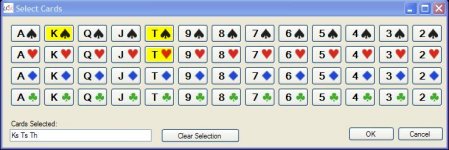
| OK here are some examples of standard flop types. X high rainbow = {Xs 4d 7h} i.e K high rainbow = {Ks 4d 7h} X high wet {Xs Jh 9d} i.e K high wet = {Ks Jh 9d} X high two tone unconnected = {Xs Jh 7h} X high two tone connected = {Ks Jh 9h} Low dry = {Xs 7h 3c} Low connected = {Xs 7h 6c} Low Connected and suited = {Xs 7h 6h} Monotone high = {Ks Js 9s} Monotone low = {8s 5s 3s} Monotone middle highly connected = {8s 6s 5s} X with high paired {Xs Ts Th} X with middle paired {Xs 7c 7d} X with low paired {Xs 3c 3h} Can anyone think of more? all you do is simply put these into the flop box example2.JPG (http://www.cardschat.com/attachment.php?attachmentid=22319&d=1248040805) |
|
#8 | ||||
| ||||
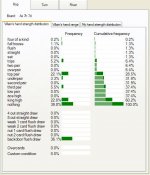
| As an example. The project unfolds like this:- Take a range i.e. Fish 50% and a range i.e. X with middle paired {Xs 7c 7d}. Lets let X = an Ace so the flop is As 7c 7d We plug that info into Poker Razor and will get the following example3.JPG (http://www.cardschat.com/attachment.php?attachmentid=22320&d=1248041196) So we can see here that our Villian pairs his Ace or better (i.e. trips) 22.1 % of the time. This isn't all that surprising as he has a lot of Aces in his range. example.JPG (http://www.cardschat.com/attachment.php?attachmentid=22324&d=1248041371) He is holding a BD flush draw 36.1% of the time, but basically he either has a pair ace, trips or nothing. So we are good to c-bet this flop (100-36.1) = 63.9 % of the time. A 1/2 pot c-bet must work at least 33% of the time to show a profit. A 3/4 pot c-bet must work 42% of the time to show a profit. So a c-bet here looks good. If called there really isn't all that much in his range that he could have so we really don't want to get any more money into the pot. (He basically has the ace.. but it could well be a weak one) Last edited by Stu_Ungar : 20th July 2009 at 12:23 AM. |
|
#11 | ||||
| ||||
| This isn't mine, it's from a video series on cardrunners by Verneer. He classified players into a few styles from a pretty extensive database of $10nl to $50nl as follows: Nit - VPIP 12/PFR 9 Tourist - VPIP 32/PFR 4.5 Bully - VPIP 36/PFR 30 Drunk - VPIP 61/PFR 29 TAG - VPIP 21/PFR 17 Not that I argue with your definition of a fish, but I'm not sure how useful that particular player type will be to break down. I don't encounter too many players that are playing that style, basically an extreme version of the tourist. Using players from my database that fit these categories I've come up with some positional VPIP/PFR %'s for each archetype So I went through my database, looking at players who had stats very close to the previously designated ones to get an idea what VPIP/PFR they had by position. Then I assigned a plausible range to those ranges with pokerstove. TAG - 21/17 The TAG's ranges for VPIP v PFR are so close that I'm only including one range. 1% ~ an unsuited non-paired hand, so remove the weakest one of those when vpip > pfr. UTG - 17/16 {22+, Any broadway except JTo} MP - 19/19 {22+, Any 2 broadway, A9s, T9s} CO - 28/27 {22+, Ax, Any 2 broadway, T9s} Button - 42/42 {22+ Ax, Any 2 cards 9+, 54s+, 64s+ 85s+, 97o+, 76o+, K8s, Q8s} NIT - 12/9 UTG - 8/4 Raise: {JJ+, AQ+} Limp: {22-TT} MP - 11/11 R: {22+, AJ+, KQ} L: N/A CO - 15/15 R: {22+, A8s+, ATo+, KQ, KJ, QJ} L: N/A Button - 27/27 R: {22+, Ax, Any broadway} L: N/A TOURIST - 32/4.5 UTG - 32/5 R: {TT+, AQo+, AJs+} L: {22+, A6o+, Axs, 65s+, 75s+, Any two cards 9+/8+ if suited} - Raises MP - 32/1 R: {KK+} L: {Same as UTG} - Raises CO - 35/5 R: {TT+, AQo+, AJs+} L: {Same as UTG + A2o+} - R's Button - 44/17 R: {22+, Any broadway} L: {22+, Ax, Any two 9+/8+ suited, 32s+, 42s+, 74s+, 86o+, 76o+} - R's BULLY - 36/30 UTG - 43/43 R: {22+, Ax, Any two 9+/8+ suited, 54s+, 64s+, 74s+, 86o+, 76o+} L: N/A MP - 34/34 R: {22+, Ax, 54s+, 64s+, Any two cards 9+/8+ if suited} L: N/A CO - 34/34 R: {Same as MP} L: N/A Button - 71/71 (This was a hard range to figure) R: Everything except: {23-2Qo, 36-3Qo, 47-4Qo, 58-5To, 69-6To, 26-2Ts, 37-3Ts, 48-4Ts, 59-5Ts, 6Ts} L: N/A DRUNK - 61/29 UTG - 48/23 R: {22+, Axs, A7o+, Any broadway} L: {22+, Ax, Kxs, Any two 9+/8+ suited, 32s+, 42s+, 74s+, 86o+, 54o+} - Raises MP - 73/27 R: {22+, Ax, Any broadway} L: Everything except: {23-2Qo, 36-3Jo, 47-4To, 58-5To, 69-6To, 26-2Ts, 37-3Ts, 48-4Ts, 59-5Ts, 6Ts} - Raises CO - 72/36 R: {22+, Ax, 54s+, 64s+, Any two cards 9+/8+ if suited} L: Everything except: {23-2Qo, 36-3Qo, 47-4To, 58-5To, 69-6To, 26-2Ts, 37-3Ts, 48-4Ts, 59-5Ts, 6Ts} - Raises Button - 65/24 R: {22+, Any two broadway, Axs, A6o+} L: Everything except: {23-2Qo, 34-3Qo, 45-4Qo, 56-5Qo, 32-92s, 43-93s, 84-94s, 95s} - Raises Okay, my head is spinning now, going to bed Last edited by Mase31683 : 20th July 2009 at 6:33 AM. |
|
#14 | ||||
| ||||
| re: Official Poker Razor Study thread Quote:
|
|
#15 | ||||
| ||||
| I open the program, and it brings up the main screen, which is just the table sitting there, and underneath the stuff with Root-Preflop-SB (SB highlighted green). I was trying out File -> New, but that didn't seem to lead to anything like what you were showing. I'm going to play with it a bit more today, see if I can think more clearly after sleep. P.S. I absolutely love the idea of this thread. To look for ourselves into what flop textures are likely to elicit folds/calls from various opponents is definitely worth whatever time goes into it. Last edited by Mase31683 : 20th July 2009 at 3:32 PM. |
|
#17 | ||||
| ||||
| I've also had a few tweaks to the hand ranges I previously put on here. Nothing too major, but a few things I'm sure were simply due to not a large enough sample size. There were a few spots where someone was raising Ax in the cutoff, but then had a more narrow ace raising range on the button, which just doesn't make sense. I'd assume things like this were due to variance over a small sample size, so I'm trying to fix those bugs to have an overall picture that makes sense. Last edited by Mase31683 : 20th July 2009 at 4:24 PM. |
|
#18 | ||||
| ||||
| Quote:
NIT 3betting ~ 3.2% {JJ+, AK} CCing ~ 4% {22+} - 3bets Tourist 3betting ~ 2% {KK+, AK} CCing ~ 20% {22+, Any broadway, 43s+ 53s+} - 3bets Bully 3betting ~ 11% {88+, ATo+ A9s+, KTs+ QTs+, KQo} CCing ~ 16% {22+, 32s+ 42s+, Axs, Any broadway, Any 2 8+ suited} - 3bets Drunk 3betting ~ 8.5 {88+, AJo+, ATs+, KJs+, KQo} CCing ~ 44% {22+ Ax, Kxs, Any 2 8+/6+ suited, 32s+, 42s+ 52s+} - 3bets TAG 3betting ~ 6% {TT+, AQ+, KQs, 65s-87s} CCing ~ 8.5% {22+, AJs, KQo, 43s+, 53s-J9s} - 3bets |
|
#19 | ||||
| ||||
| Great stuff guys, but there's no need to get too specific with it. The more specific you get, the tougher and more tedious the work gets, plus getting as specific as including 67s but not 34s for ex. often won't make that much of a difference. Rounding off rough cold calling ranges is a good start. Just remember you'll be looking at tons of flop textures for each player type. I guess it'll be easier with the 'save player profile' option thing, but don't make it too hard on yourselves |
|
#20 | ||||
| ||||
| Yeah, being able to save them is great, makes everything a breeze after you have the ranges. I think that the CC and 3bet figures are definitely the more important ones too now that I think about it. The only pots we're really playing are where someone CC's us, or limps, then calls the raise which I think is going to narrow their range more toward the original CC range anyway. I did that first go round really late/early and wasn't thinking about what the data would actually be used for, although it's not without purpose, and since I already did it I did save those profiles as well. Last edited by Mase31683 : 20th July 2009 at 7:26 PM. |
|
#21 | ||||
| ||||
| re: Official Poker Razor Study thread Good idea Stu. Quote:
Or maybe I've been overthinking how my opponent's adjust. Or overvaluing the probably slight card difference per situation. |
|
#22 | ||||
| ||||
| HI Mase Really good work. Yeah I think we should just stick to the CC ranges for a bit. Then move onto other ranges later. Like most things, we didn't realise what we were getting into at the start, so multiple ranges for different villain types seemed a good idea, but I think if we try and do this in too much detail we will end up with so much data that we won't be able to digest it!! |
|
#23 | ||||
| ||||
| %6 looks fine, sure. Again though whether he's polarizing his range or not can change player to player. I do see people 3betting suited connectors sometimes, but in general a 'good' tag will flat them and 3bet more hands like 47s or J8s that they can't quite call with. Again, not a huge adjustment though. I was going to say that I think we're getting too specific with player types, when we should be keeping them relatively simple and getting more into complex board textures, but this could turn out well. |
|
#24 | ||||
| ||||
| Quote:
But that doesn't give you an accurate range if you plug it into a program - they always give you the top %X instead of specific hand types. Just think about how a reg or fish you often see plays, and just plug in a rough range in pokerazor. Like a tag probably 3bets JJ+/AK/maybe AQ, calls with suited connectors 56s-KQs, pairs up to 99 or TT, stuff like ATs+/AQo, 3bets everything better and folds everything worse. Then a passive fish may call all suited aces and a lot more one-gap suited connectors, more unsuited connectors, etc etc. |
|
#26 | ||||
| ||||
| First range Fish 10% {TT-66, AQ, AJs-A2s, KQs, QJs} Scenario 1 A high rainbow As 4d 7h Here the villain has Set 4% Top pair 48% Underpair 24% BD FD 34.7% C-bets have to work 33-47% of the time depending on size. So this is close and probably not worth c-betting. He often has an ace or a pair. If he calls (which he will do a lot) we just wont know what to do unless he peels with air a large % of the time. Secnario 2 K high rainbow Ks 4d 7h Set 3.4% Top pair 3.4% Underpair 20.5% Third pair 10.2% A high 54.5% BD flush draw 40.9% Here c-betting looks good. He almost never has the king. His range is weighted towards pairs or A-high. He may peel and pick up a FD on the turn. This is useful to know as the presence of a flush card may justify him sticking around on the turn. Scenario 3 K high wet = {Ks Jh 9d} Set 3.4% TP 3.4% Second pair 6.9% Third pair 10.3% Low pair 20.7% Straight 0% 4 out Straight Draw 36.8& BD FD 40.2% Basically this flop doesn’t hit him at all. He does pick up a draw 36.8% of the time and a flush card coming on the turn may account for him sticking around or getting aggressive if that added to his straight draw. C-bet Scenario 4 A high wet = {As Jh 9d} Set 4.1% 2 pair 5.4% Top pair 48.6% Second pair 4.1% Third pair 8.1% 4 out straight 5.4% BD FD 33.8% The interesting thing here is how low his straight draw possibilities are. You are basically facing a made hand (Ax) or nothing, with a few 2 pairs thrown in. Oddly enough I wouldn’t c-bet this. If we have the best hand then its not worth raising. We aren’t giving up much by letting him draw anyway. Scenario 5 K high wet = {Ks Jh 9d} Set=3.4% TP =3.4% Second pair =6.9% Third pair =10.3% Low pair = 27.7% Ace high =55.2% 4 out straight =36.8% BD flush = 40.2 C-bet for sure. He often holds A-high so if he peels flops with A high, then this is a good flop to charge him on. He has a Gunshot about 1/3 of the time and will be picking up a FD on the turn 40% of the time. Scenario 6 A high two tone unconnected = {As Jh 7h} Set = 4.1% Trips= 5.4% TP = 48.6% SP=4.1% 3P=24.3% LP = 8.1% 4 Out straight draw = 5.4% Weak 2 card FD 1.4% Nut FD 12.2% This is another odd one. I would have assumed that this flop would hit him in terms of FD’s however He has a FD only 12% of the time. The bigger danger is him having A-High. This means he is likely to be charging hands if he has it. C-bet and he will often be raising, so its not worth C-betting. Scenario 7 K high two tone unconnected = {Ks Jh 7h} Set = 3.4% TP = 3.4% SP= 6.9% 3P=24.1% LP=6.9% A High = 55.2% 4 SD = 23% Weak FD = 1.1% Nut FD = 10.3% BD FD =13.8% C-bet. His range is weighted towards Aces so Kings are only a small portion of it. He could easily be peeling with A high. FD’s again are lower than expected yet higher than when the high card is an Ace. Scenario 8 Low dry = {9s 7h 3c} Set = 7.1% OP= 7.1% TP = 3.5% UP =7.1% SP= 3.5% 3P=10.6% A high= 51.8% BD FD = 42.4% Overcards =37.6% A large portion of his range here are Over cards. He has a higher than usual chance of having a set. A high is still a big part of his holdings. I really wouldn’t C-bet this simply because he is very likely to peel and if he does lots of cards look scary. We wont know where we are so I don’t think it should be c-bet. Scenario 9 Low connected = {9s 7h 6c} Set 11% OP 7.3% TP 3.7% UP 7.3% SP 3.7% 3P 3.7% AHigh 53.7% 4 out SD 17.1 8 out 12.2% BD FD 43.9% Overcards 39% I wouldn’t bet this. He has almost a 20% chance of SD combined with an almost 40% chance of picking up a FD and 39% of his current holdings are over cards. I would be more inclined to check/fold or check and bet the turn as long as no cards come completing his draws or over cards come which could shut me down. Scenario 10 Low Connected and suited = {9s 7h 6h} Flush 12% Set 11% Op 7.3% TP 3.7% UP 7.3% £pair 3.7% Ahigh 43.9% 4 out SD 14.6% 8 out SD 11% Weak 1 card FD 11% Overcards 39% I don’t like c-betting this unless the villain is very weak. He has so many draws or hands that do well on this board that if he calls we are just in a terrible spot and OOP. If he calls then it really doesn’t matter what we have we are done with the hand. So I see no point in c-betting. Scenario 11 Monotone high = {Ks Js 9s} Flush 10% TP 3.4% SP 6.9% tP 10.3% LP 20.7% AHIGH 44.8% 4 out straight draw 35% Weak 1 card FD 17.2% Nut 1 card flush draw 3.4% This isn’t a bad flopp to c-bet. 10.3% of the time he has a flush. 1/3 of the time he has a GS straight draw, but the rest of the time he dosnt have a hand he will go broke on. Scenario 12 Monotone low = {8s 5s 3s} Flush 11.4% Set=3.4% OP 13.6% TP 3.4% UP 13.6% SP 3.4% 3P 3.4% AHigh 40.9% 4 out SD 6.8% Weak 1 card FD 17% Overcards 40.9% I would c-bet this. He has a made flush 10% of the time, but it’s a scary board and the vast majority of his holdings do not look good on this board. Scenario 13 Monotone middle highly connected = {8s 6s 5s} Flush 11.8% Set 7.1% OP 14.1% TP 3.5% UP 7.1% 2P = 3.5% 3P 3.5% Ahigh 42.4% 4 out ST 14.1% 8 out SD 10.6% Weak 1 card Fd 14.1% Overcards 42% Im not so keen on c-betting this pot because of the increase in straight draws he has. Other than that its pretty much the same as the last example. But now he has more reasons to peel. In the previous example I was c-betting with the hope of winning there and then, and perhaps occasionally fire again on the turn, however I’m not so keen with the additional straight draws he has. Scenario 14 X with high paired {Ks Ts Th} 4 of a kind 1.2% Trips 2.3% TP 3.5% 3P 3.5% A high 60.5% 4 out SD 23.3% 8 out SD 4.7% Weak FD 1.2% Nut 2 card FD 11.6% BD FD 14% The most striking thing about this is his relative lack of FD’s. He has more GS’s than FD’s. C-bet this for sure. He is likely to be chasing SD’s or FD’s however if non come in and you are faced with a large river raise, there really isn’t much he can have other than a monster. Knowing this I still feel it’s a pot to get involved with as the monsters are incredibly unlikely. Scenario 15 X with middle paired {9s 7c 7d} 4 of a kind 1.2% FH 3.6% Trips 3.4% OP 7.2% TP 3.6% UP 7.2% 3P 7.2% AHigh 57.8% BD FD 43.4% Overcards 38.6% C-bet. There are some monsters out there but most of the time he has A high. Even if he peels a lot, you would probably be good here to fire a second barrel. Scenario 16 X with low paired {5s 3c 3h} Trips 2.2% OP 33% TP 3.3% A high 52.7 4 0ut Sd 8.8% BD flush 39.6 OC 52.7% C-bet. He almost never has anything in his range he wants to play here. He may well peel he has tons of Overcards and A High hands. This really don’t hit him at all. ---------------------------------------------- That took ages!!! Feel free to suggest different courses of action. Its just my interpretation of the data rather than a definative way of playing each scenario. |
|
#28 | ||||
| ||||
| re: Official Poker Razor Study thread What types of hands do we think villains are going to continue with after the flop? Obviously we expect them to continue with top pair and better. I'd guess that a lot of 2nd pairs will call a cbet. What I'm not sure about is how villains will react with hands like Ace high. I see them make calls with these hands, but how often are they doing it? Getting a better idea of these things will help us get a better estimate of what kind of fold equity we actually have on various flops. |
|
#30 | ||||
| ||||
| Quote:
A good example, straight from one of my analyses linked to in the OP was a Axx board. I was surprised to find that, even though loose passive players have a way wider range, it still hits that flop WAY harder than it does a taggy player since the loose passives play so many offsuit aces. Just a general pokerazor breakdown of two different rough player types on the same flop texture, and from now on I don't cbet Axx as often or for as big of a fraction of the pot against a fish. But basically going into the next level of questions (will he continue with x hand, is he raising or flatting it, etc) is kinda useless without a concrete example. You have to decide in the hand if he's likely to float overs/ace high/bottom/middle pair/backdoor draws, and what he's raising vs flatting, etc etc etc. Each opponent is different, and all Pokerazor does for you is break down how their range connects with the flop, not how the player reacts. |
|
#31 | ||||
| ||||
| Figured I'd keep the format like Stu started. Scenarios vs Tourist (32/4) when he Cold Calls Scenario 1 Ace high rainbow ![]() Top Pair+ 17.4% Underpair 12.4% King high 19.9% Nothing 31.5% Scenario 2 King high rainbow ![]() Top Pair+ 17.4% Underpair 12.4% Ace high 19.9% Nothing 31.5% Scenario 3 King high wet ![]() Top Pair+ 24.9% 2nd Pair 15.8% Ace high 14.0% Nothing 17.5% Gutshot 43.4% OESD 1.8% Scenario 4 Ace high wet ![]() Top Pair+ 17.9% 2nd Pair 15.8% King high 14% Nothing 24.6% Gutshot 15.8% OESD 8.8% Scenario 6 Ace high 2-tone unconnected ![]() Top Pair+ 17% 2nd Pair 17% King High 14% Nothing 22.8% Gutshot 26.3% F-Draw 5.3% Scenario 7 King high two tone unconnected ![]() Top Pair+ 17% 2nd Pair 17% Ace High 14% Nothing 22.8% Gutshot 17.5% OESD 8.8% F-draw 5.3% Scenario 8 Low dry ![]() Top Pair+ 15.3% Ace High 19.4% King High 19.4% Nothing 27.5% Gutshot 9.7% OESD 4.9% Overcards 58.3% Scenario 9 Low connected ![]() Top Pair+ 15.3% Ace High 19.4% King High 19.4% Nothing 27.5% Gutshot 36.3% OESD 9.4% Overcards 58.8% Scenario 10 Low Connected and suited ![]() Top Pair+ 18.3% Ace High 19.5% King High 19.5% Nothing 24.4% Gutshot SD 36.2% OESD 9.3% F-draw 5.3% Overcards 58.5% Scenario 11 Monotone high ![]() Top Pair+ 30.6% 2nd Pair 15.7% Ace High 13.1% Nothing 13.1% Gutshot 41.9% F-Draw 22.3% Nut draw 3.9% Scenario 12 Monotone low ![]() Top Pair+ 24.9% Ace High 18.1% King High 18.1% Nothing 24.2% F-draw 27.8% Scenario 13 Monotone middle highly connected ![]() Top Pair+ 25.8% Ace High 18.2% King High 18.2% Nothing 21.9% Gutshot 10.9% OESD 7.3% F-draw 27.9% Nut draw 3.6% Scenario 14 X with high paired ![]() Top Pair+ 27.5% Ace High 14.9% Nothing 29.8% Gutshot 16.7% OESD 7.4% F-draw 6.9% Scenario 15 X with middle paired ![]() Top Pair+ 15.4% Ace High 19.5% King High 19.5% Nothing 30.9% Gutshot 8.1% OESD 3.3% Overcards 58.5% Scenario 16 X with low paired ![]() Top Pair+ 23.2% Ace High 19.2% King High 19.2% Nothing 33.6% Overcards 70.4% -------------------------------- You were right Stu, that took longer than I'd imagined. I don't want to extrapolate this data any further just yet. However I will say that Nothing and Ace/King high make up the vast majority of ranges here. As long as our opponent is folding these hands with some regularity, c-betting should prove quite profitable in the majority of these flops. |
|
#32 | ||||
| ||||
| Quote:
I went a little bit further and put a suited high card on the turn and a suited low card just to see how often he picks up the FD on the turn and it was only about 11-12% of the time so really all we need to be worried about would be a higher Gutshot straight draw percentage and an Ace. I don't know i might be way off base here |
|
#33 | ||||
| ||||
| Quote:
Even if he is tight, we arent representing al that much. What could we have? a 9? maybe we have some straight cards.. but they dont form much of our range. This flop dosnt hit us. If ever there was a time for him to peel this is it. Then what do we do on the turn? I just don't see it as a good flop to c-bet |
|
#34 | ||||
| ||||
| Quote:
|
Number of Posts: 41
Number of Authors: 10