

How To Play Poker (for Beginners)
 Reviewed by Chris ‘Fox’ Wallace
 Beginner-friendly
 11 minute read
Poker is a fun game of wits, strategy and skill, but you don’t need to be a famous poker player or a math whiz to play it well and win money!
Below you’ll find all the info you need to know to learn how to play poker. Texas Hold’em poker is one of the easiest games to learn, as well as one of the most enjoyable and widely played, so it’s a great place to start. Here’s a quick rundown of the rules.
Try your hand at free Texas Hold’em at our no-risk practice tables! Play now, no download required.
How to Play Poker: The Basics
We’ll look more closely at Texas Hold’em below, but first there are a few principles you should know that are common to almost all forms of poker.
What Beats What?
A poker hand consists of your best five cards, and can take any of the following forms (from best to worst):
| Rank | Hand name | Example | Description |
|---|---|---|---|
| 1 | Royal Flush | 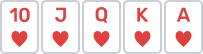 | Description A Royal Flush is made out of 10, Jack, Queen, King, Ace, all of the same suit. |
| 2 | Straight Flush | 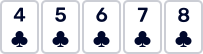 | Description A Straight Flush is five cards in a row, all in the same suit. |
| 3 | Four of a Kind | 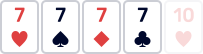 | Description A Four of a Kind is the same card in each of the four suits. |
| 4 | Full House | 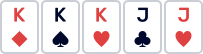 | Description A Full House is a pair plus three of a kind in the same hand. |
| 5 | Flush | 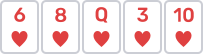 | Description A Flush is five cards in the same suit, not in numerical order. |
| 6 | Straight | 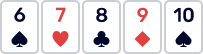 | Description A Straight is five cards in numerical order, but not in the same suit. |
| 7 | Three of a Kind | 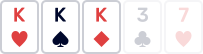 | Description Three of a Kind is three of one card and two non-paired cards. |
| 8 | Two Pair | 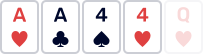 | Description Two Pair is two different pairings of the same card in one hand. |
| 9 | One Pair | 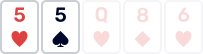 | Description One Pair is a pairing of the same card. |
| 10 | High Card | 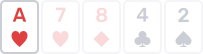 | Description A High Card refers to a hand with no matching cards. |
A hand from higher up the list will always beat any hand below it. You can bookmark our poker hands page to have this useful information available whenever you play online, but you’ll surely learn to remember poker basics like this soon enough. You may also want to review our poker rules for beginners page.
How Betting in Poker Works
Poker games all have ‘betting rounds’, but what exactly does this mean?
In a betting round players wager on the strength of their hands. For a betting round to end, every player must either fold or put the same amount of chips in the pot (or, if they can’t, all their remaining chips).
With a good hand, you want to raise to get more chips in the pot. Therefore, betting is a sign of strength so players with weaker hands are likely to fold. But remember that if the other players all fold you’ll win the pot, regardless of the hand you have. So why not simply pretend to be strong, bet big and push the other players out of the hand?
That’s called bluffing, and it can be very effective. But what happens if someone raises you when you’re bluffing? If betting is a sign of strength, they must be even stronger to raise your bet, right? But…what if they’re bluffing too? Welcome to poker!
Learn Texas Hold’em – A Step by Step Example
When learning how to play poker online, it’s helpful for beginners to watch a hand from start to finish, so let’s review how a Texas Hold’em hand would play out, just like we saw in the video above. In this poker tutorial we’ll break it down, step-by-step (and remember, any player can fold whenever it’s their turn to act):
1. Pre-Flop
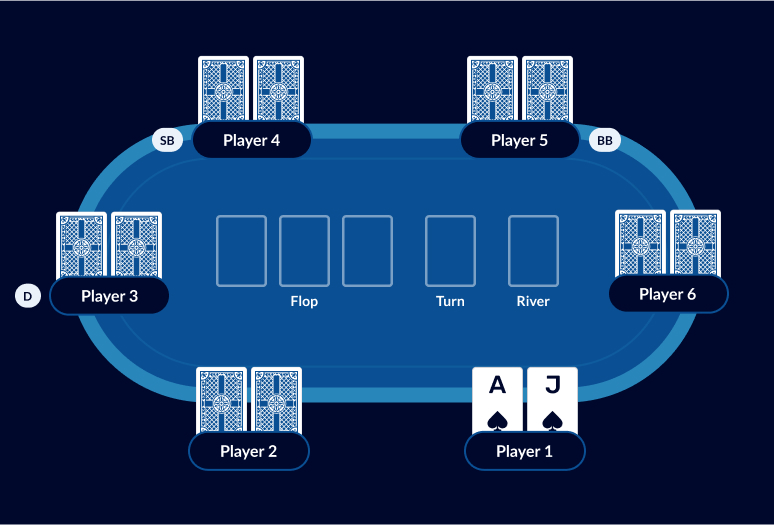
The player to the left of the dealer position must put in a small bet called the small blind, with the player to their left putting in a larger bet called the big blind. Every player then receives two hole cards: cards that can only be used or seen by them. This starts off the pre-flop betting round, as – moving around the table, clockwise – any player who wishes to stay in the hand must at least match the amount of the big blind.
Sometimes no player will call, which means the player in the big blind position wins the pot and the hand is over. Sometimes a player will raise, all others will fold, which means the raiser will win the pot and the hand is over. Players who call each other’s bets and stay in the hand then see the flop.
In this example, the player in middle position raises with A J, and two players call.
2. The Flop
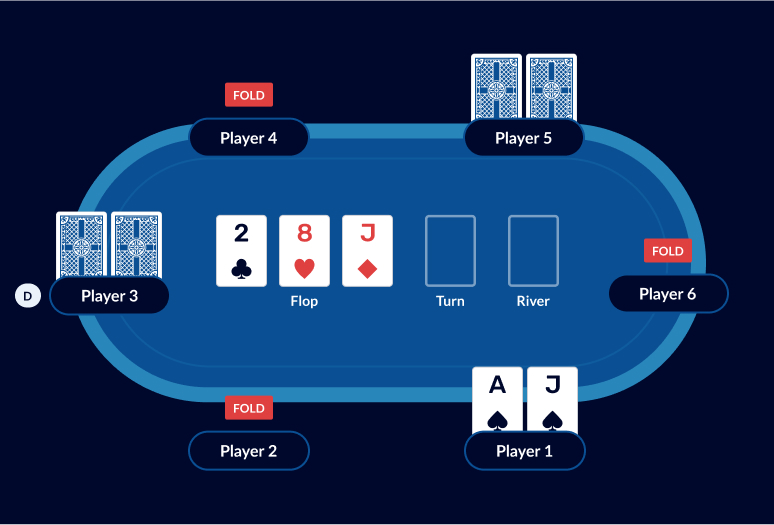
The dealer places three communal cards in the center of the table, which can be used by any player to make their strongest five-card poker hand. A betting round follows, during which players who wish to continue in the hand must again make sure they put in the same amount as each other.
Unlike pre-flop, there are no blinds to get the betting started, so it is possible for all players to check (i.e. bet nothing) and stay in the hand. If one player chooses to bet chips, however, any other players must call that amount to stay in.
The player in middle position has flopped a pair of jacks – the top pair – and so makes a bet. The player on the button calls.
3. The Turn
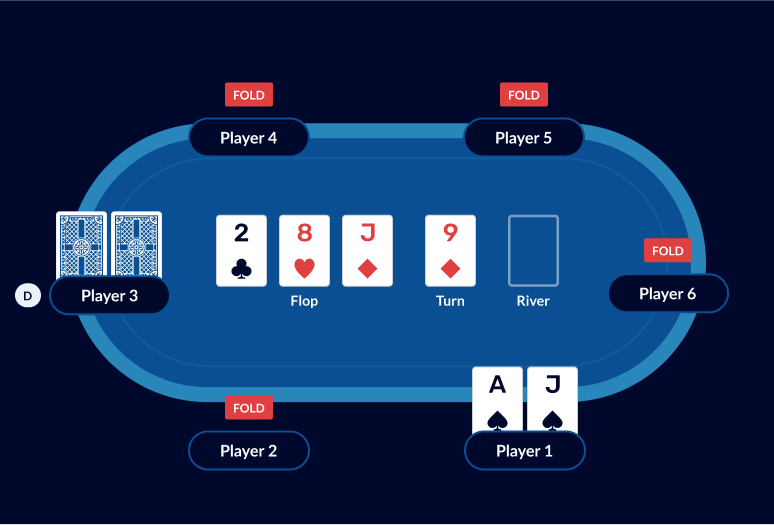
A fourth communal card is dealt, alongside the three from the flop, and another betting round takes place.
In our example we can see the turn has made a straight now possible, while two diamonds mean a possible flush draw too. The player in middle position makes another bet, and is called again by the button.
4. The River
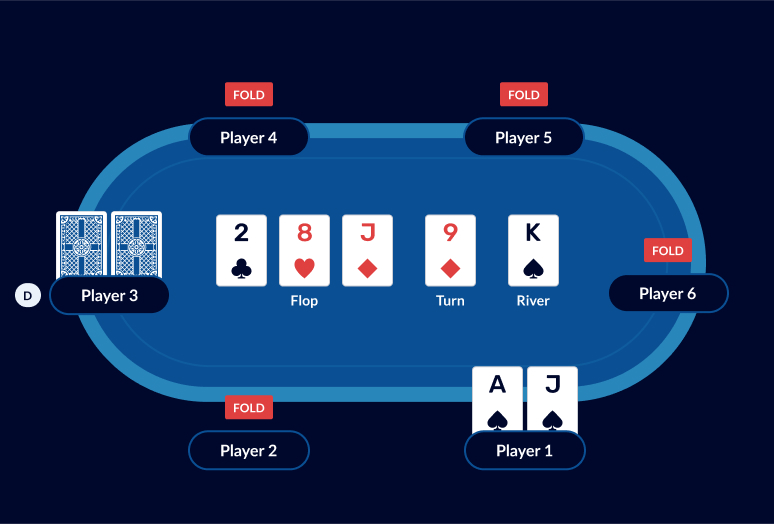
A fifth and final communal card is dealt, so all remaining players now have seven cards from which to construct their best five-card hand. The final betting round ensues, ending when every remaining player has put the same amount of chips in the pot (or, if they have fewer than they need, all their chips), or when all players but one have folded.
The K on the river means there is no flush possible, but the player in middle position still fears the possibility of a straight, or that their opponent has a king in their hand for a higher pair than their jacks. Both players check.
5. The Showdown
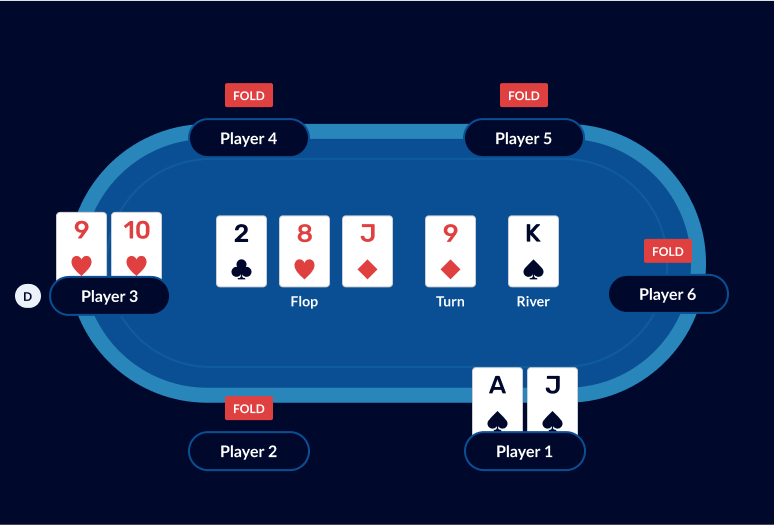
Assuming more than one player remains, players reveal their hands face up and the strongest hand – as per the rankings above – wins the pot.
In our example the pair of jacks beats the pair of nines of the player on the button, who was probably hoping to hit a straight.
Different Types of Poker Game
‘How do you play poker?’ isn’t quite as simple a question as it might first appear. That’s because, while Texas Hold’em is one popular variety of poker, lots of other games can be played – both offline and in the 24/7 poker world of online rooms. We’d recommend checking them out once you have a good understanding of Hold’em.
Many other poker games like Omaha, Seven Card Stud and hi-lo games use the same principles and ideas as Hold’em, so once you’ve got the hand rankings memorized and have some experience following the betting in betting rounds, they can be a great way to add some variety to your poker diet!
One of the most important things to be aware of, however, is how poker ring games and tournaments differ from one another.
Poker Ring Games
Ring games, also known as cash games or simply ‘cash’, are ongoing poker games where each player may buy in for different amounts, and may leave at any time. As players leave, new players can join, meaning these games can technically go on forever.
Ring game tables are usually defined by their stakes, which in turn relate to the size of the blinds. Buy-ins are often capped at 100x the big blind, so a ring game table with blinds of $0.01 / $0.02 may be referred to as a $2 table, or a $0.01 / $0.02 game.
Success in ring games comes from establishing good habits and solid fundamental poker play, but emotional control is also a key element. If the game technically never ends, then you only leave when you choose to do so or when you run out of chips. Make sure it’s the former!
Poker Tournaments
Each player in a poker tournament pays an entry fee and then starts with the same amount of chips, and the size of the blinds increases at set intervals until only one player remains. Rising blinds means it’s not possible to wait for good hands as the blinds eat away at your stack, so winning any poker tournament requires aggression and good timing, as well as a dose of good luck.
It’s not just the winner who receives prize money in most poker tournaments, as most pay out the top 10-20% of the field with prizes increasing in value as they near the last player standing. One aspect that attracts many players is how tournaments have a limited downside – you can only ever lose what you pay to enter – yet often have a very large upside. It’s possible to win many, many times what you paid to enter a tournament, and big tourneys such as the World Series of Poker (WSOP) Main Event offer prize money in the millions, even for those who don’t actually win.
Poker tournaments can take different formats, but the main ones to be aware of are:
These begin as soon as the required number of players have registered.
Multi-Table Tournaments, or MTTs, start at scheduled times, feature a large number of players and may offer a guaranteed prize pool.
Instead of cash prizes, satellites award entry to more expensive tournaments. When Chris Moneymaker won the WSOP in 2003 he didn’t pay the $10,000 entry fee, but instead won his entry through a cheap online satellite.
What’s the Difference Between Limit, No Limit and Pot Limit?
Limits in poker refer to how the betting works. You’ve likely heard of ‘No Limit’ Texas Hold’em, but how about ‘Limit’ or ‘Pot Limit’ games?
- No Limit
Just as it sounds, there is no limit to the amount you can bet at any one time in these games. When going ‘all-in’ is a weapon in anyone’s arsenal, you never know when a small pot might suddenly turn into a huge one!
Texas Hold’em is almost always played no limit these days, but other games like Omaha, Omaha Hi/Lo and Draw Poker are also often no limit games.
- Pot Limit
In a pot limit game, the maximum any player may raise is dictated by the size of the pot. Let’s say the small blind is $1, the big blind is $2, and you want to raise the maximum, or ‘raise the pot’. Calling the $2 bet you are facing would make the pot $5, which would then be your maximum raise, so to raise the pot you would need to put in $7. Handily, when playing online, you can bet the maximum at the push of a button, without doing any mental calculations!
Omaha is the game most often played in a pot limit format.
- Limit Poker
In limit poker games, players can only ever bet or raise in set amounts. A limit game with stakes of $1/$2, for example, means all bets must be in units of $1 for the early betting rounds (pre-flop and on the flop in Hold’em, for example), and in units of $2 for the later betting rounds.
Seven Card Stud and other stud poker games like Razz are usually played in the limit format.
Advice for New Players
The tips above give you the poker basics you need to get started, or a guide to ‘How to Play Poker for Dummies’. We all have to start somewhere, after all!
If you’re looking to advance your game, however, we’d recommend learning the basics of pot odds, gaining an understanding of which poker starting hands to play, and giving some thought to poker bankroll management.
Interested in fast-tracking your poker progress? Check out our 30-day poker course, where pro players explain the concepts and principles of winning poker in a series of short videos, helping you learn to play poker at your own pace.
You’ll also find many more articles available in our Strategy section to help you become a winning poker player online, as well as a community of friendly fellow players ready to answer your questions in the Forum.
What Now?
Looking for more, right now? Check out the Poker Starting Hands guide for the lowdown on which hands to hold and which hands to fold.
Looking to level up your Poker Skills further?