

 Reviewed by
 Omaha Hi-Lo is the perfect game to learn if you already know how to play Texas Hold’em. The rules are very similar but there are some great new twists: you get four hole cards, and you can win half the pot with the worst hand.
Omaha Hi-Lo Poker – Video Tutorial
How to play Omaha Hi Lo Poker
If this sounds to you like a great way to create more action and bigger pots, you’re right! Let’s explore what makes Omaha Hi-Lo such a fun game, how to read different hands and how to play high-low poker.
Omaha Hi-Lo Rules
If you’ve read the rules to Omaha poker, you’ll know that it plays identically to Texas Hold’em – some even call it ‘Omaha Hold’em’ – with the following exceptions:
- Players all receive four hole cards instead of two
- Exactly two hole cards, plus three community cards, must be used to create your five-card poker hand
Where Omaha Hi-Lo – also known as Omaha Hi-Lo Split, Omaha 8/b (‘eight or better’) or simply O8 – differs from traditional Omaha is that half the pot is awarded to the lowest qualifying hand. This is where the ‘hi-lo’ in the name comes from, and why poker games of this type are often called ‘split games’.
Making the High Hand
Every hand of Omaha Hi-Lo awards at least half the pot to the best traditional five-card poker hand. These follow the same rules as most other poker games: a royal flush is the best possible hand, while a hand with no pairs, straights or flushes (known as a ‘high card’ hand) is the worst.
Our guide to poker hands is a useful page to bookmark for new players – why not leave it open the next time you’re playing online poker?
That’s just half the story when it comes to Omaha Hi-Lo, though, because half of each pot goes to the lowest hand – if it qualifies!
Making the Low Hand
So, how does a hand qualify for the low half of the pot in Omaha Hi-Lo? There are just a couple of requirements:
- The five-card hand can contain no pairs
- The hand can contain no cards higher than an 8 (hence the name ‘eight or better’)
That’s it! Aces count as low cards when making a low hand, and straights and flushes don’t count against you. The best low hand, therefore, is A-2-3-4-5 of any suits (also known as ‘The Wheel’).
Note that, as exactly three community cards must be used to create your final hand, the board must have three unpaired cards ranked eight or below for a low hand to be possible.
If no low hand is possible, or if no players have a qualifying low hand, the entire pot is won by the high hand.
Going Both Ways – Scooping the Pot
It’s possible to win both high and low pots, either by using different cards to make a high and a low hand, or by making a low hand which is also a winning straight or flush.
‘Scooping the pot’ in this way is the ideal outcome of any Omaha Hi-Lo hand, as it’s more than twice as profitable as winning half the pot. Starting hands with the potential to scoop the pot are therefore very valuable in Omaha Hi-Lo.
Reading Omaha Hi-Lo Poker Hands
Figuring out the winners of an Omaha Hi-Lo hand can be trickier than it would be with a Texas Hold’em hand, but with just a little practice you’ll soon get the hang of it. Here are a few example hands to start with.
In each hand the river has been dealt and all betting is over. Can you tell who has won each pot, and with what? Don’t forget that each player must use exactly two cards from their hand to make either a high or low hand.
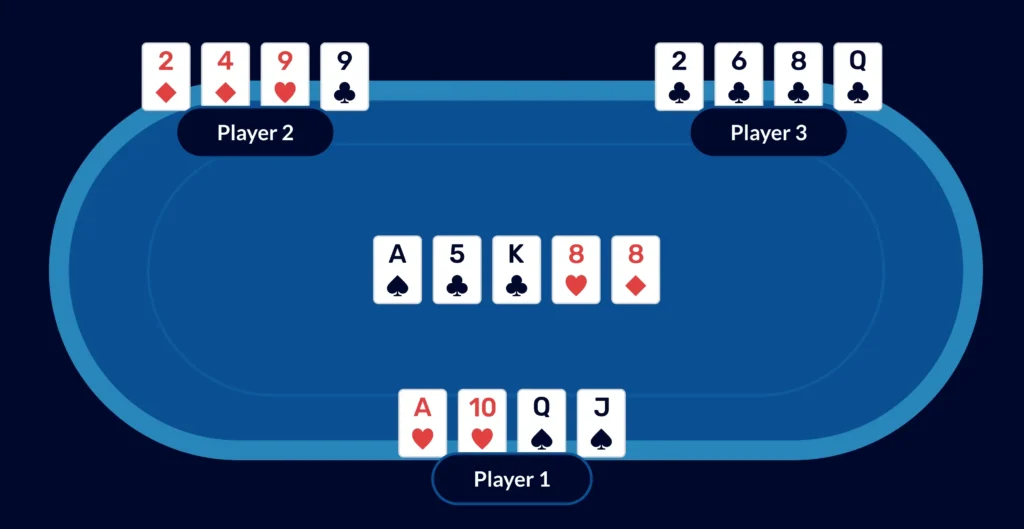
- The high half of this pot is won by Player 3, using the 8
 and Q in their hand to make three-of-a-kind with an A-Q kicker (8 8
 8
8 Q A
Q A )
) - The low half of this pot is won by Player 2, using the 2 and 4 to make an eight-high (A2 4 5 8)
It may look like Player 1 has a straight and Player 3 has a flush, but when you remember each player must use exactly two cards from their hand, you’ll see these hands aren’t technically possible.
Player 3 has a decent low hand with an eight-high (A 2 5 6 8), but Player 2 wins the low. This is because, while they might both share the same highest card (8), Player 2’s next highest card is a 5, which beats Player 3’s 6 as it is a lower rank.
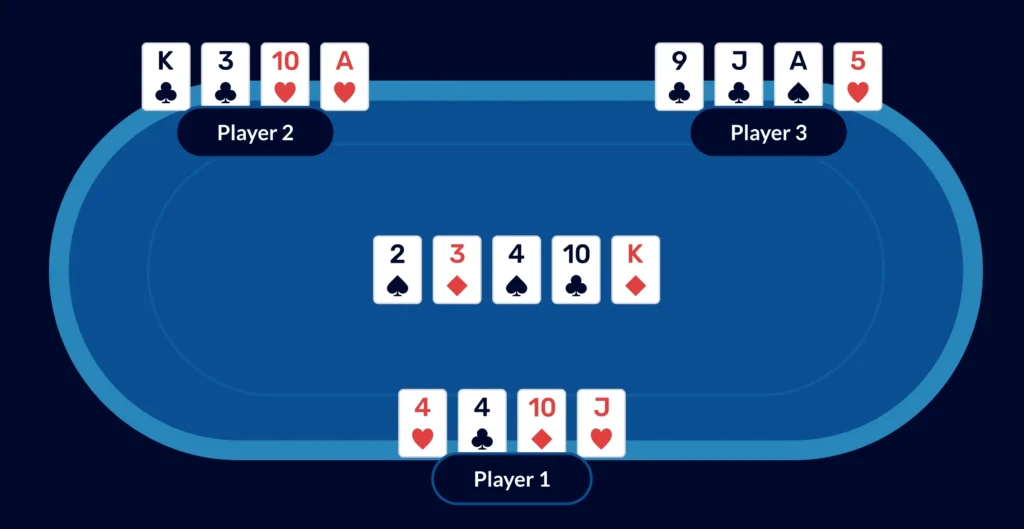
- Player 3 has a straight for the high hand, and The Wheel (A-2-3-4-5) for the low hand, so scoops the pot and wins it all!
In this case, the straight and the low hand use the same cards, because while straights do not count against you when making a low hand, they can still be used to win the high half of the pot.
Player 1 may look like they have a full house, but they would need to use three of their hole cards so it is not possible. Player 2 started out with the potential to make a better low hand than Player 3, as their A-3 is lower than A-5, but pairing their 3 meant they ended up without a low hand at all.
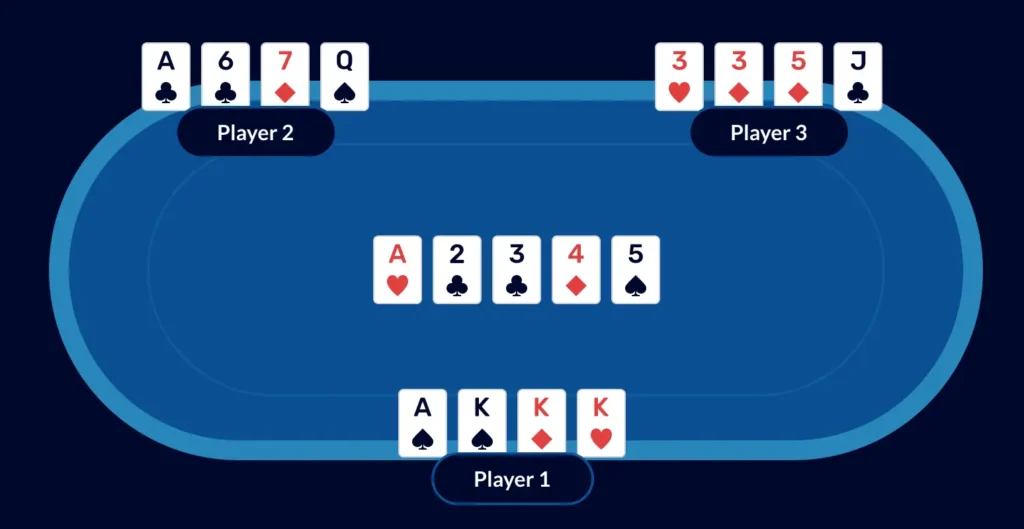
- Player 2 has a straight to the 7, using the 6-7 in their hand along with the 3-4-5 on the board, to win the high half
- Player 3 wins the low, using the 3-5 in their hand along with the A-2-4 on the board to make The Wheel. They don’t win the high half, as Player 2 has a higher straight.
Notice that, as all players must use exactly two hole cards, it is not possible to ‘play the board’ as you might in Texas Hold’em, so the straight (The Wheel) made by the community cards is not available to play as it is.
Player 1 was dealt three kings in their hole cards, but three-of-a-kind is difficult to improve given that only two hole cards must be used.
Limit, Pot Limit or No Limit?
Omaha Hi-Lo used to be best known as a limit game, meaning all bets would be in two predetermined units – a smaller amount up to the turn, then a larger amount on the turn and river. It’s still possible to find limit Omaha Hi-Lo games, both live and online, but these days you’re probably just as likely to find this game being played at pot-limit or no-limit tables.
How Does Pot-Limit Omaha Hi-Lo Work?
In any pot-limit poker game, the maximum raise is determined by the size of the pot. When working out how much you can raise, it’s always important to factor in any chips you’ll have to put in the pot to call, as those will contribute to the pot size and so therefore your raise size.
Let’s say you’re under the gun, first to act pre-flop, and you wish to raise the pot. The small blind is $0.50 and the big blind is $1: how much can you raise?
Firstly, in calling the bet (the big blind) you are adding $1 to a pot which already has $1.50 in it, making the total pot $2.50 – your maximum raise. To raise the pot, then, you must put $3.50 in the pot ($1 for the call, plus $2.50 for the raise).
Thankfully, when playing in an online poker room you can simply hit a button to raise the maximum! For more details of how pot-limit games work, see our Pot Limit Omaha page.
No-Limit Omaha Hi-Lo
As you might expect if you’ve played No-Limit Texas Hold’em, or any other no-limit games, this version of O8 lets any player bet all they have, whenever it’s their turn to act. These kind of big-bet games have grown in popularity, and many Omaha Hi-Lo games you’ll find online are likely to be no-limit variants, both in cash games and tournaments.
Compared with Texas Hold’em, Omaha games give players many more ways to make potential hands. Four hole cards means six different two-card combinations, so winning hands in Omaha and Omaha Hi-Lo tend to be stronger. Here’s how those two extra cards create extra combos:
Your hand
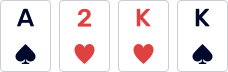
Combo possibilities
1
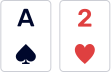
Possible nut low
2
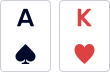
High connected cards, potential to make high pairs or a straight
3
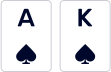
Suited connectors, as above but could also make the nut flush in spades
4
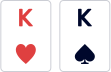
A high pair, could make a set or full house
5

Could make the 2nd nut flush in hearts
6
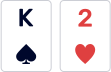
No extra value
Of these six combinations, four have great potential to make a strong hand, in various different ways depending on the texture of the flop (the K 2 adds no value that the K 2 doesn’t already have, and likewise the A K compared with the A K). It’s these hands with the potential to make different kinds of big hands – both high and low – that are the most playable.
As draws are more common and more powerful, being able to bet large amounts to discourage players from drawing to stronger hands is a useful weapon in your arsenal. This is much less effective in limit games, where the amount you can bet is severely restricted.
Omaha Hi-Lo Strategy
For many players starting out with Omaha Hi-Lo, part of the challenge lies in rethinking some of the fundamentals they’ve learned through playing Texas Hold’em.
Big pairs like aces and kings, or high card combinations like A-K and A-Q, don’t have the same power to dominate a hand in Omaha that they do in Hold’em.
This is down to the fact that so many more card combinations are out there, so the chances of hitting a straight, a flush, or any other draws are so much greater; a single big pair is unlikely to still be ahead by the river.
When it comes to Omaha Hi-Lo strategy, there are a few basic rules we’d recommend taking to heart:
- Your four hole cards need to work well together, with the potential to make lots of different hands (or draws) on the flop
- If your hand contains a ‘middle’ card (e.g. 7, 8, 9, T) it should have three very strong cards to go with it, as middle cards are less useful than high or low cards
- Remember the importance of position, and relax your starting hand requirements if you have position and no one has shown strength
- If you’re only drawing to half the pot, make the relevant adjustments when calculating your pot odds
- Don’t get too attached to your hand, as you can flop the nuts and still be easily outdrawn
Getting Quartered
Our last piece of advice concerns what happens when you share half the pot with another player who has the same hand you do. This can be damaging to your stack, as well as hard to avoid – especially when you hold a strong hand like the nut low.
The nut low in Omaha Hi-Lo is a clearly defined two-card combination, so anyone holding that combo at the river knows they cannot be beaten for the low half of the pot. This can lead to confident betting, and calling, but it’s not uncommon for multiple players to be holding that unbeatable combination.
When that happens, the winners of that half of the pot must share it. The fewer players in the pot, the more damaging it can be, as it means you will have contributed a greater share of the pot – imagine putting in 33% of the chips in a three-handed pot, then taking back 25%, or putting in close to 50% of the chips in a heads-up pot and only taking back 25%.
Knowing when you’re splitting the low requires paying close attention to how your opponents are betting. Treading carefully through a hand, even when you’re holding the nut low, runs contrary to the way we think about the nuts in a game like Texas Hold’em.
Try It For Yourself
Omaha Hi-Lo is a great, action-packed game that throws up new challenges and decisions for even the most experienced Texas Hold’em player, yet is easy to pick up and play. Why not check out our recommended online poker sites and find a new place to play today?
Looking for more variety in your poker diet? Why not check out a fun draw poker game like Badugi, or an even more unusual poker variety like Open Face Chinese Poker? You’ll find rules and advice on these and other games in our poker games section.
Looking to level up your Poker Skills further?