You are using an out of date browser. It may not display this or other websites correctly.
You should upgrade or use an alternative browser.
You should upgrade or use an alternative browser.

Steveg1976
...
Silver Level

I first read M in Harrington on Hold'em. It is refering to you chip stack in relatation to the blinds and antes in a tournament. For instance 1500 chips with 10/20 blinds gives you an me of 1500/30=50 so you would say your M is 50.
When there are antes you have to count the players at the table with you so if your stack is 50K with 1000/2000 and 100 ante at a 6 person table the calculation becomes 50,000/(3000+600) or 13.89.
M is used to determine strategies for stages of the tournaments and effects the way you should be playing your hands.
I hope that isn't too confusing.
When there are antes you have to count the players at the table with you so if your stack is 50K with 1000/2000 and 100 ante at a 6 person table the calculation becomes 50,000/(3000+600) or 13.89.
M is used to determine strategies for stages of the tournaments and effects the way you should be playing your hands.
I hope that isn't too confusing.

Jack Daniels
Charcoal Mellowed
Silver Level
M is a concept introduced and referred to in depth in the Harringon on Hold'em books.
Simply put, M is how many orbits you can survive at the current blind and ante levels (without respect to the fact that blinds and antes will go up).
Formula: Stack / (BB + SB + (#players*Ante)) = M
Some examples:
Stack = $1500
Players = 10
Blinds = $10/$20
Antes = 0
M = 1500/(20+10+(10*0)) = 1500/30 = 50
Stack = $5500
Players = 10
Blinds = $200/$400
Antes = 50
M = 5500/(400+200+(10*50)) = 5500/1100 = 5
In the first one, M=50 which is huge. But in the second, M=5, which means you're sitting in a bad situation. But that's only half the puzzle. Once you know your M, you can use it along with a general M strategy to help you play accordingly.
EDIT: Couldn't find the link for some reason, so here's the next best thing:
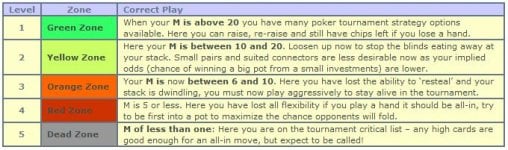
Simply put, M is how many orbits you can survive at the current blind and ante levels (without respect to the fact that blinds and antes will go up).
Formula: Stack / (BB + SB + (#players*Ante)) = M
Some examples:
Stack = $1500
Players = 10
Blinds = $10/$20
Antes = 0
M = 1500/(20+10+(10*0)) = 1500/30 = 50
Stack = $5500
Players = 10
Blinds = $200/$400
Antes = 50
M = 5500/(400+200+(10*50)) = 5500/1100 = 5
In the first one, M=50 which is huge. But in the second, M=5, which means you're sitting in a bad situation. But that's only half the puzzle. Once you know your M, you can use it along with a general M strategy to help you play accordingly.
EDIT: Couldn't find the link for some reason, so here's the next best thing:
Last edited:
Jack Daniels
Charcoal Mellowed
Silver Level
Also, I know it's a little beyond the scope of your question, but there is also the concept of the "effective M". M is calculated as shown above when you generally have 9-10 people at the table. I'll usually go down to 8 as well (since PS starts with 9 in most cases). But under 8, effective M comes into play because the blinds and antes come around faster/more often. If you are at a 10 seat table with only 6 players seated, then the formula simply becomes: (Stack / (BB + SB + (#players*Ante))) * (#seated/#seats). Once you find your effective M, you use the same chart as above as your guide.
I like examples:
Stack = $1500
Players = 6 of 10 seats
Blinds = $10/$20
Antes = 0
M = (1500/(20+10+(6*0))) * (6/10) = (1500/30)*0.6 = 50(.6) = 30
Stack = $6000
Players = 3 of 10 seats
Blinds = $200/$400
Antes = 50
M = (6000/(400+200+(3*50))) * (3/10) = (6000/750)*0.3 = 8(.3) = 2.4
See the huge difference in the second one? Instead of M=8, effective M is 2.4 which then means red zone instead of orange zone.
EDIT: oh, as a simple rule, when calculating effective M, just use 10 seats at the table anyway because calculating x/10 on the fly is easier than x/9.
I like examples:
Stack = $1500
Players = 6 of 10 seats
Blinds = $10/$20
Antes = 0
M = (1500/(20+10+(6*0))) * (6/10) = (1500/30)*0.6 = 50(.6) = 30
Stack = $6000
Players = 3 of 10 seats
Blinds = $200/$400
Antes = 50
M = (6000/(400+200+(3*50))) * (3/10) = (6000/750)*0.3 = 8(.3) = 2.4
See the huge difference in the second one? Instead of M=8, effective M is 2.4 which then means red zone instead of orange zone.
EDIT: oh, as a simple rule, when calculating effective M, just use 10 seats at the table anyway because calculating x/10 on the fly is easier than x/9.
T
Toad
Rock Star
Silver Level
Also, I know it's a little beyond the scope of your question, but there is also the concept of the "effective M".
Thanks again...I'm kind of a math geek so more info is always good.

J
j0na1234
Rock Star
Silver Level
I never look at this M factor thing. The only thing i keep in mind is how many times Big blinds (+ante) i have. Less then 10 is poor, more then 20 is safe.
By the way: which Harrington book is it, that talks about M factor?
By the way: which Harrington book is it, that talks about M factor?

DKnight10
Enthusiast
Silver Level
The "M" is mainly used for MTT's when ante's are significant. Instead of a STT when antes dont play a big rold, you have to consider them as part of the dead money. The "m" is totaled as all the dead money combined (ante+small blind+big blind) relative to your stack. If playing STT, it is easier to use big blind/stack method, MTT when ante is significant, use the M factor


CAPT. ZIGZAG
Legend
Silver Level
Steveg1976
...
Silver Level
Do you guys actually use this M thing in your poker play. Do you keep track of it when playing in a tournament?
Yes, you should know your M every time you are dealt a hand.

Makwa
Undesirable Predator
Silver Level
M is just a formal way of estimating stack size, table position and tourney position play, most pros do it without thinking about Ms at all. Very useful for dweebs like me. Join the HOH discussion stickied upstairs and find out more (when we get to it); meanwhile Harrington is essential so get going! Basically, you dont want to be playing without info that everyone else has, and most solid players know Harrington.

FatBasset
Rock Star
Silver Level
Herrington has become like a textbook for tournament poker. I also don't get exact with "M" while I'm playing because I'm mostly trying to focus my attention on the play at the table. I do however, think about my stack size in respect to the blinds as far has hand selection and how I will play a hand.